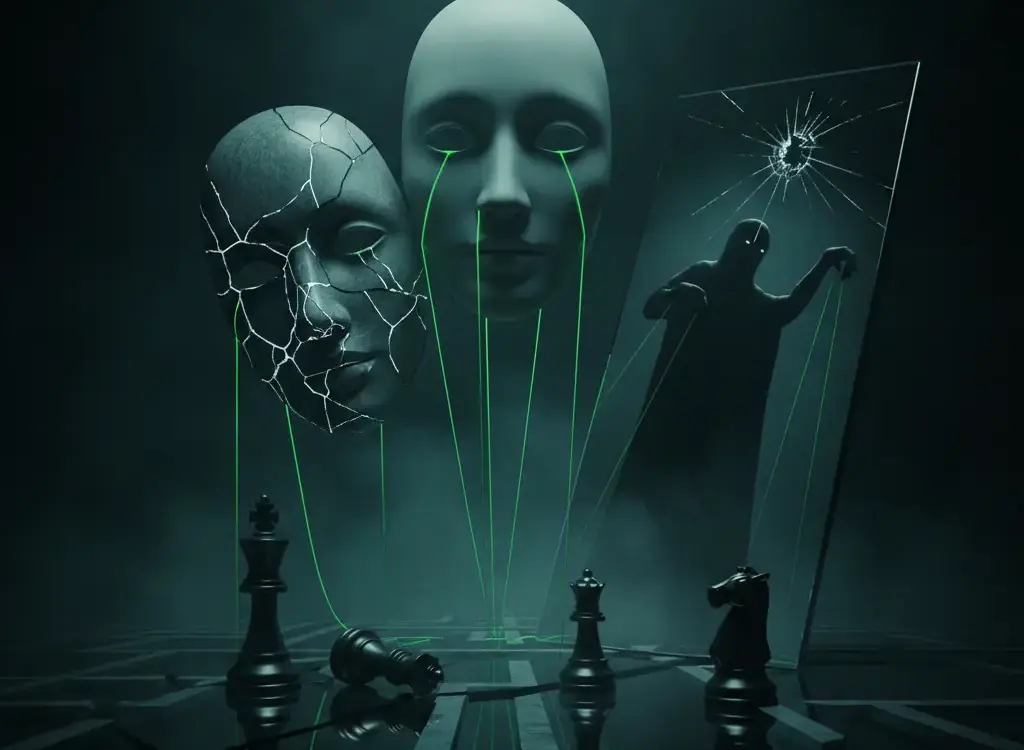
Picture a senior executive — impeccably dressed, effortlessly persuasive, admired by shareholders and feared by subordinates. He has never raised a fist. He has, however, systematically dismantled careers, fabricated data to meet quarterly targets, and charmed a board of directors into ignoring compliance reports. Nobody calls him dangerous. They call him driven. This is not a Hollywood villain. This is what psychopathy frequently looks like in the real world — and understanding it begins with the concept known as the dark triad.
The dark triad is a cluster of three overlapping but distinct personality constructs: narcissism, Machiavellianism, and psychopathy. First formally proposed by Paulhus and Williams in 2002, the framework identifies a constellation of socially aversive traits that, taken together, predict exploitation, manipulation, and interpersonal harm — without necessarily predicting violence. Of the three, psychopathy carries the heaviest clinical weight and the most robust neuroscientific backing. This article focuses on that construct: what it actually is, what it is not, and what it means for anyone who has to navigate someone who scores high on it.
Featured definition: The dark triad refers to three subclinical personality traits — narcissism, Machiavellianism, and psychopathy — that share a tendency toward callousness and interpersonal manipulation. Psychopathy is distinguished by affective deficits, reduced fear response, and a characteristic failure to learn from punishment, underpinned by identifiable neurobiological differences.
1. The Construct Problem: Psychopathy Is Not a Synonym for Evil
Let’s be precise about terminology, because the popular discourse almost never is. Psychopath and sociopath are not clinical synonyms. “Sociopath” has no formal standing in either DSM-5 or ICD-11. The DSM-5 diagnosis most closely associated with this cluster is Antisocial Personality Disorder (ASPD) — but ASPD and psychopathy overlap without being identical. ASPD diagnosis requires a documented history of conduct disorder before age 15 and a persistent pattern of violating others’ rights. Psychopathy, as measured by Robert Hare’s Psychopathy Checklist-Revised (PCL-R), captures something both narrower and more precise.
The PCL-R’s two-factor model distinguishes between:
- Factor 1 (Interpersonal-Affective): Glibness, grandiosity, pathological lying, lack of remorse, shallow affect, callousness, failure to accept responsibility.
- Factor 2 (Lifestyle-Antisocial): Impulsivity, irresponsibility, parasitic lifestyle, early behavioral problems, criminal versatility.
Many high-functioning individuals score dramatically high on Factor 1 while scoring moderately or low on Factor 2. These are the executives, surgeons, attorneys, and politicians who function — often brilliantly — within institutional structures. Christopher Patrick’s Triarchic Model adds further resolution: boldness (fearless dominance), meanness (callous exploitation), and disinhibition (poor impulse control). A corporate psychopath may score high on boldness and meanness while exhibiting relatively controlled disinhibition. The serial killer caricature, by contrast, tends to show all three.
Approximately 1% of the general population meets the threshold for psychopathy on the PCL-R. Among incarcerated populations, that figure rises to roughly 15–25% (Hare, 2003). The math matters: most people with psychopathic traits are never incarcerated. They are your colleagues, perhaps your managers — rarely your local news headline.
2. The Neuroscience: What Is Actually Different Inside
The neurobiology of psychopathy is not metaphor. It is measurable. James Blair’s foundational research at the National Institute of Mental Health demonstrated reduced amygdala reactivity in individuals with high psychopathic traits — specifically, a diminished response to fearful and distressed facial expressions. Where most people experience an involuntary physiological signal when they perceive someone suffering, individuals with psychopathy show significantly attenuated activation in the circuitry responsible for that response.
Kent Kiehl’s neuroimaging work, conducted in large part using a mobile MRI scanner in correctional facilities, documented reduced gray matter volume in paralimbic regions — including the amygdala, anterior cingulate cortex, and orbital frontal cortex — in high-scoring PCL-R individuals. These are not peripheral findings. They implicate the neural architecture of emotional learning, moral decision-making, and response inhibition.
What this means in practical terms: the person with psychopathic traits does not experience fear the way you do. They do not acquire conditioned emotional responses through punishment the way you do. When they observe distress in another person, the automatic affective signal — the one that underlies empathy and guilt — is substantially quieter. This is not chosen indifference. It is a structural difference in affect processing. Understanding this distinction is important both for accuracy and, as we will see, for thinking realistically about intervention.
Essi Viding’s developmental research at UCL identifies callous-unemotional (CU) traits in childhood — diminished empathy, shallow affect, limited guilt — as early markers of this trajectory. CU traits show substantial heritability estimates (around 50–67%) while remaining sensitive to environmental moderators including parenting quality and early trauma. The gene-environment interaction is real; neither pure biology nor pure experience tells the complete story.
3. The Dark Triad in Context: Where Psychopathy Operates
In Corporate and Institutional Settings
Paul Babiak and Robert Hare’s work in Snakes in Suits (2006) documented what organizational psychology had been slow to name: psychopathic traits are not merely compatible with professional success — in certain environments, they confer competitive advantage. Emotional detachment facilitates high-stakes decisions. Fearlessness supports risk tolerance. Charm and superficial likability ease upward networking. Studies estimate that the prevalence of psychopathy in senior corporate roles may be three to four times the general population rate, though methodological variation across studies warrants caution with that figure.
Within the dark triad framework, corporate psychopathy often presents alongside high Machiavellianism — the strategic, long-horizon manipulation of others for personal gain. The critical distinction: Machiavellianism involves calculated, strategic thinking that can coexist with normal affective responses. Psychopathy involves an affective deficit that makes certain behaviors not just permissible but emotionally invisible. Conflating the two produces analytical error.
In Interpersonal and Intimate Relationships
For readers who have encountered these traits in personal relationships, the experience is characteristically disorienting. The initial phase — idealization, intensity, apparent emotional attunement — is followed by what clinicians sometimes describe as mask slippage: increasing disregard, contempt, exploitation. The confusion is compounded by intermittent reinforcement, where moments of warmth alternate unpredictably with coldness or cruelty.
This is not the same as narcissistic abuse cycles, though the dark triad’s overlap means both constructs may be simultaneously relevant. The affective deficit specific to psychopathy means the pain registered in the other person simply does not function as the social regulator it does for most people. It does not produce guilt. It may produce mild curiosity, irritation, or nothing at all.
For more on how these patterns unfold in close relationships, see our related article on covert narcissistic traits in the workplace and our piece on intermittent reinforcement as a manipulation tactic.
4. A Brief Timeline: How the Field’s Understanding Has Evolved
- 1941: Hervey Cleckley publishes The Mask of Sanity, the foundational clinical description of psychopathy — charming, intelligent, unreliable, guiltless.
- 1980: DSM-III introduces Antisocial Personality Disorder, shifting diagnostic focus toward observable behavior rather than internal affective deficits — a move Hare and others would critique for decades.
- 1991: Robert Hare publishes the PCL-R, providing a standardized, research-validated instrument. Psychopathy research finally has a common metric.
- 2002: Paulhus and Williams formally propose the dark triad framework, integrating psychopathy with narcissism and Machiavellianism as related but distinct constructs.
- 2006: Babiak and Hare publish Snakes in Suits, directing research attention toward corporate and professional contexts.
- 2010s: Neuroimaging work by Kiehl, Blair, and others establishes a credible biological substrate. Viding’s genetic studies clarify heritable and environmental contributors.
- Present: Debate continues around treatability, dimensional versus categorical conceptualization, and the ethics of early identification of CU traits in children.
5. People Also Ask: Common Questions Answered Accurately
Is every dark triad individual a psychopath?
No. The dark triad is a framework, not a diagnosis. High scores on Machiavellianism or subclinical narcissism do not imply psychopathy. Psychopathy specifically requires evidence of affective deficits — reduced fear response, shallow emotional processing, impaired guilt — that are not definitional features of Machiavellianism or narcissism. The constructs correlate; they do not collapse into one.
Can psychopathy be treated?
This is where the field has moved considerably. The classic claim — psychopathy is untreatable — deserves significant qualification. Randall Salekin’s meta-analysis found evidence that treatment can reduce recidivism and behavioral problems, particularly in younger individuals and when interventions target specific deficits rather than attempting broad personality change. Decompression models in correctional settings, and approaches that leverage cognitive rather than affective pathways, have shown modest but real effects. “Untreatable” is not a scientifically defensible absolute. What is accurate is that treatment is difficult, progress is often limited, and outcomes vary substantially by individual profile and treatment context.
How do you protect yourself from someone with high psychopathic traits?
Not by trying to detect them in seconds — that promise belongs to pop psychology content, not science. What research does support: behavioral consistency over time is a more reliable signal than any single interaction. High psychopathic individuals typically show inconsistency between their stated values and observable actions, a pattern of leaving damage in their wake (relationships, professional contexts), and a notable absence of genuine accountability. Protection is less about identification and more about maintaining clear, documented boundaries and seeking independent perspectives when your own judgment feels compromised. For a deeper analysis of manipulation tactics and how to maintain cognitive clarity under social pressure, see our article on gaslighting as a social engineering mechanism.
6. What This Actually Means If You Are Close to Someone with These Traits
The clinical literature can feel abstract when the subject is someone you have worked alongside for years, or loved. A few things are worth stating plainly. First, understanding the neurobiological basis of psychopathy does not require you to excuse the harm caused. Structural brain differences explain behavior; they do not obligate tolerance of it. Second, the absence of guilt in the other person does not mean your pain is invalid — it means the usual social mechanism for repair is unlikely to function. Expecting remorse as a precondition for your own recovery is a trap worth recognizing. Third, if you are trying to assess whether someone in your life has these traits, the most reliable method is not a checklist you found online. It is consultation with a licensed forensic or clinical psychologist who can conduct a proper assessment.
Conclusion: The Dark Triad Is Not a Monster Story
The dark triad — and psychopathy within it — is a legitimate area of psychological science with a robust empirical foundation. Its most common manifestations are not dramatic. They are quiet, institutional, and interpersonal. Understanding them requires resisting both the romanticization of the charming predator and the sensationalism of the violent killer. What the data shows is more unsettling in its ordinariness: people who move through the world with diminished affective feedback, who cause harm not from passion but from indifference, and who often do so in offices, courtrooms, and boardrooms rather than the locations true crime favors.
The question worth sitting with is not whether you can identify these individuals on sight. It is whether you understand how institutions, relationships, and cultures can create conditions where dark triad traits are not just tolerated but rewarded — and what that says about the environments we have collectively built.
References
- Babiak, P., & Hare, R. D. (2006). Snakes in suits: When psychopaths go to work. HarperCollins.
- Blair, R. J. R. (2007). The amygdala and ventromedial prefrontal cortex in morality and psychopathy. Trends in Cognitive Sciences, 11(9), 387–392.
- Cleckley, H. (1941). The mask of sanity. Mosby.
- Hare, R. D. (2003). The Hare Psychopathy Checklist-Revised (2nd ed.). Multi-Health Systems.
- Kiehl, K. A. (2014). The psychopath whisperer: The science of those without conscience. Crown Publishers.
- Patrick, C. J. (2010). Operationalizing the triarchic conceptualization of psychopathy. In C. J. Patrick (Ed.), Handbook of psychopathy (pp. 335–369). Guilford Press.
- Paulhus, D. L., & Williams, K. M. (2002). The dark triad of personality: Narcissism, Machiavellianism, and psychopathy. Journal of Research in Personality, 36(6), 556–563.
- Salekin, R. T. (2002). Psychopathy and therapeutic pessimism: Clinical lore or clinical reality? Clinical Psychology Review, 22(1), 79–112.
- Viding, E., Blair, R. J. R., Moffitt, T. E., & Plomin, R. (2005). Evidence for substantial genetic risk for psychopathy in 7-year-olds. Journal of Child Psychology and Psychiatry, 46(6), 592–597.