Why this site exists
Most of what circulates online under the label “dark psychology” is not psychology. It is a mix of self-help platitudes, viral TikTok diagnoses, recycled checklists about “how to spot a narcissist in 30 seconds”, and books that promise to teach you “the manipulation techniques the elite don’t want you to know.” Almost none of it engages with the actual research literature. Almost none of it acknowledges that personality psychology, social influence, and clinical assessment are serious disciplines with replication problems, methodological debates, and decades of accumulated evidence.
I started darkpsychology.eu because I wanted a place where the shadow side of human behaviour could be written about with the same rigour applied to any other branch of psychology — without sensationalism, without infantilising the reader, and without pretending that complex constructs reduce to a five-minute read.
This is a popular-science blog. It takes the science part seriously.
Who writes here
I am Octavio Ortega Esteban, a psychologist and engineer based in Toledo, Spain. My academic and professional path is unusual, and I think it shapes the way this site reads.
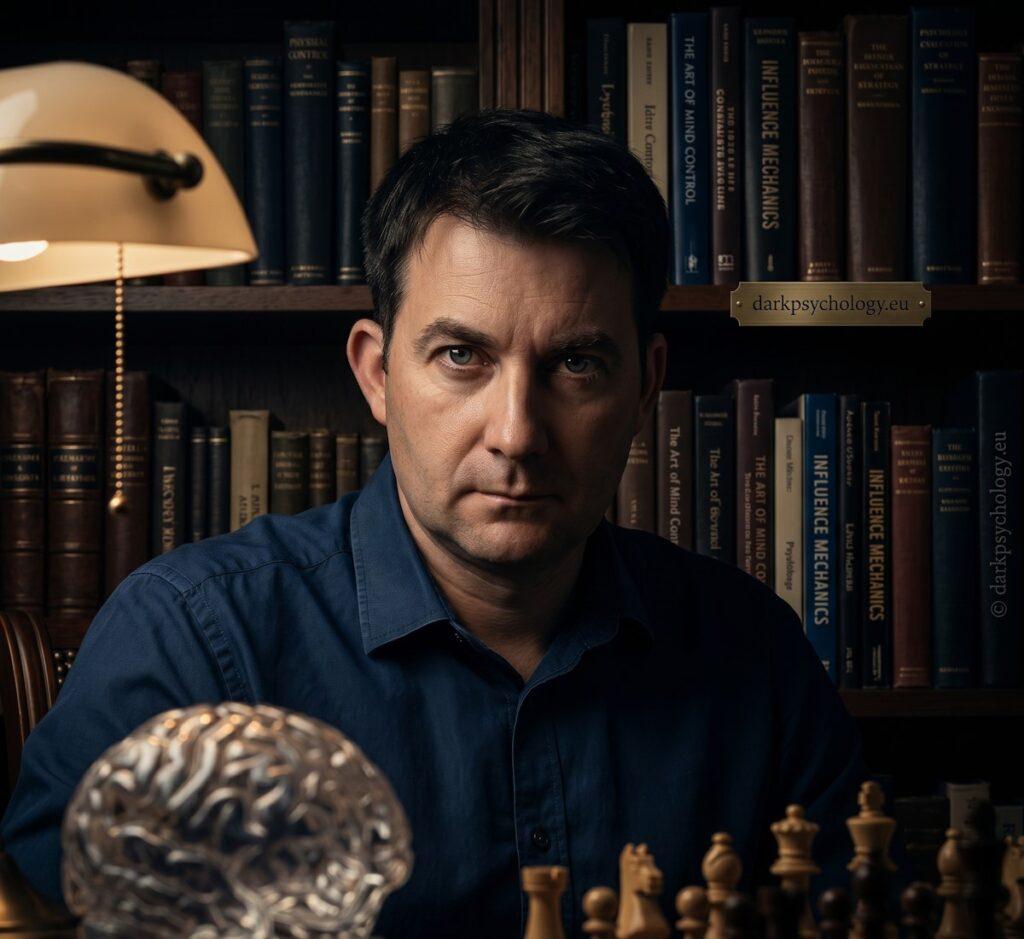
I hold a degree in Psychology from the Universitat Oberta de Catalunya (UOC). I also hold a Higher Vocational Degree in Web Application Development, fifteen-plus years of experience in the technology sector, and certifications in cybersecurity. Currently I work for a defense technology company in Spain, where I have spent years as a technical instructor in radar surveillance systems and where I am now transitioning to a role in cyberdefense — specifically in cognitive warfare analysis, OSINT, and disinformation detection.
That last part matters for understanding why this blog exists. Cognitive warfare is, at its core, applied dark psychology at scale: the systematic exploitation of cognitive biases, emotional vulnerabilities, identity dynamics, and influence mechanisms — directed not at one person but at populations, institutions, and decision-makers. The same principles that explain how a narcissistic partner gaslights one person explain, structurally, how a disinformation campaign reshapes a public conversation. Understanding the small scale clarifies the large scale, and vice versa.
darkpsychology.eu is the popular-science side of that interest. The technical and operational side stays where it belongs.
What this site is
darkpsychology.eu is one of several language sites in a network of psychology blogs I run on related themes. The English-language site focuses specifically on the dark side of personality and influence:
- Body language — without the pseudoscience that has flooded the field
- Cognitive biases — beyond the LinkedIn listicle, with replication caveats and adversarial uses
- Emotional intelligence — including its limits and dark applications
- Machiavellianism — the strategic vertex of the Dark Triad
- Manipulation — with clinical precision, not viral folk-diagnosis
- Narcissism — distinguishing trait, pattern, and personality disorder
- Persuasion — and where it crosses into manipulation
- Psychological abuse and power dynamics — coercive control as a clinical and legal framework
- Psychological self-defense — what the evidence supports, what it doesn’t
- Psychology of power and status — including the studies that did not survive replication
- Psychopathy — beyond the Hollywood serial killer
- Social influence — conformity, obedience, polarisation, with modern critiques
Every category page lists the topics covered and the editorial framework I apply to them.
What this site is not
- It is not a clinical service. I do not diagnose readers, partners of readers, or anyone else. The clinical concepts described here (Narcissistic Personality Disorder, psychopathy, complex PTSD, trauma bonding) require formal evaluation by a licensed mental health professional to be applied to a real person. Recognising patterns is not the same as making a diagnosis, and the difference matters.
- It is not therapy. Reading articles here will not replace working with a psychologist or psychiatrist. If you are in an active situation — abusive relationship, mental health crisis, suicidal thoughts — please contact specialised services. I list resources by region in the Disclaimer and on the Contact page.
- It is not a research journal. Articles cite peer-reviewed studies, recognised academic books, and reliable secondary sources, but the format is divulgative. Where the evidence is contested, I say so.
- It is not a platform for AI-generated slop. Editorial content is written and reviewed by a human editor. Some illustrations are AI-generated and disclosed as such in the captions. AI tools are used as research and drafting support — not as a substitute for editorial judgement.
- It is not monetised. As of the date of this page, darkpsychology.eu carries no advertising, no affiliate links, and no sponsored content. If that changes in the future, sponsored material will be clearly disclosed in line with EU advertising regulations.
Editorial principles
Every article on this site is written under a small set of explicit rules:
- No diagnoses of identifiable people — public figures, relatives of readers, ex-partners, no one. Pattern description is fine; clinical labelling of a real person is not.
- No replication-naïve citation. Stanford Prison Experiment, ego depletion, power posing, bystander effect, classic Milgram interpretation — these are cited with the methodological critiques that have qualified them, not as if the field stood still in 1971.
- Clinical vs. popular distinctions stay sharp. “Gaslighting” is a sustained pattern, not a single lie. “Narcissist” is not a synonym for “selfish ex”. “Psychopath” and “sociopath” are not interchangeable. Words mean things.
- Sources are real. Every academic citation refers to a real author and a real publication. No invented references, no AI-hallucinated DOIs.
- The reader is treated as an adult. That means no condescension, no “10 simple tips”, no fear-mongering, and no promise that any article will let them detect a manipulator in thirty seconds. Real understanding takes longer than that, and pretending otherwise is itself a form of manipulation.
Editorial tone
The site’s voice is what I think of as noir-divulgative. Cinematic where the topic earns it, technically precise where the evidence demands it, slightly disenchanted by default. Dark psychology is not entertainment, but it is also not a Sunday-school sermon. The tone tries to honour both facts.
A note on language and audience
darkpsychology.eu is the English-language node of a multilingual network. Parallel sites cover related material in Spanish, French, and Norwegian. The English site is written for a wide readership — UK, Ireland, US, Canada, Australia, and non-native English readers across Europe and beyond. References to crisis services, legal frameworks, and cultural context are deliberately international.
How to reach me
For editorial feedback, topic suggestions, collaboration proposals, press inquiries, or legal matters, see the Contact page. I read everything and respond when I can. I cannot, and will not, provide individual psychological consultation by email — for the reasons explained on the Contact page itself.
Final note
If you are here because something in your life — a relationship, a workplace, a family system, a community — has felt psychologically wrong in a way you cannot quite name, I hope the articles help you find the language. Naming a pattern is not the same as solving it, but it is often where the solving starts.
Thank you for reading.
— Octavio Ortega Esteban, Toledo, Spain
Last updated: 27 April, 2026